


The telecommunications landscape in Mexico is undergoing a profound transformation. In recent months, the government has renewed the institutions responsible for overseeing, regulating, and promoting competition within this strategic sector for national development. These shifts mark the beginning of a new regulatory era one that seeks to respond to the demands of an increasingly digital society and a rapidly evolving technological environment.
At Spark Telecomm, we are committed to remaining at the forefront of this transition, ensuring that our solutions continue to meet the highest standards of reliability, innovation, and compliance.
A New Regulatory Framework for the Digital Era
Telecommunications are no longer limited to calls or messages they now encompass high-speed internet, data infrastructure, online banking, and streaming services. To address these challenges, the government created two new agencies: the Telecommunications Regulatory Commission (CRT) and the National Antitrust Commission (CNA).
These entities replace, respectively, the Federal Telecommunications Institute (IFT) and the Federal Economic Competition Commission (COFECE), as part of a structural reform aimed at adapting regulation to today’s digital environment.
The CRT, established on October 17, 2025, is responsible for regulating telecommunications and broadcasting. Meanwhile, the CNA, ratified by the Senate on October 14 of the same year, has the mission of ensuring free competition and combating monopolies across all markets, including digital ones.
Members of the CRT
The CRT’s board consists of five commissioners with staggered terms, all nominated by the Presidency and ratified by the Senate:
- Norma Solano Rodríguez, President, Law graduate from UNAM specialized in digital transformation. Serving a seven-year term, she will focus on strengthening regulatory independence and promoting digital inclusion.

- Ledénika Mackensie Méndez González, with a background in political science and public administration, will serve a three-year term, developing social connectivity projects.

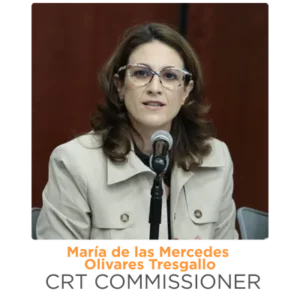
- María de las Mercedes Olivares Tresgallo, audience advocate, with a four-year term, will focus her efforts on freedom of expression and user protection.
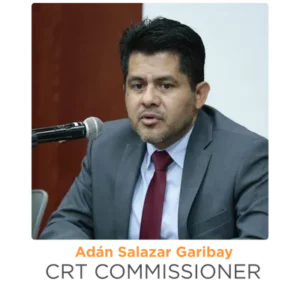
- Adán Salazar Garibay, communications and electronics engineer, will hold a five-year term, specializing in spectrum use and orbital resources.
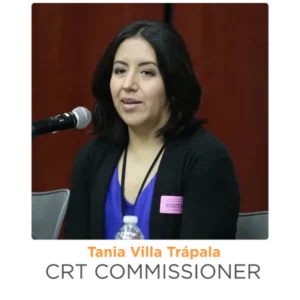
- Tania Villa Trápala, telematics engineer with international experience, will serve for six years, leading initiatives in regulatory modernization and technological innovation.
Members of the CNA
The National Antitrust Commission (CNA) also has five commissioners, appointed for staggered terms ranging from three to seven years to ensure institutional stability:
- Andrea Marván Saltiel, President, Law graduate and Master’s degree holder from the University of Chicago, recognized for her expertise in competition policy and international participation. She will serve a three-year term.

- Ana María Reséndiz Mora, economist from UNAM and specialist in economic analysis, will serve four years, bringing technical rigor to market investigations.

- Óscar Alejandro Gómez Romero, economist with a career in competitiveness and regulatory improvement, will serve a five-year term

- Ricardo Salgado Perrilliat, expert in public and corporate law, will hold a six-year term, focusing on strengthening the organization’s legal framework.

- Haydee Soledad Aragón Martínez, PhD in Sociology from El Colegio de México, will serve a seven-year term, centering her work on the social dimension of competition and protecting vulnerable sectors from economic power.

Towards a Modern and Inclusive Digital Future
These new institutions represent a firm commitment to transparency, innovation, and the democratization of access to technology. Although some aspects remain to be defined, this reform marks the beginning of a new chapter in Mexico’s digital ecosystem one where connectivity, security, and informational freedom are united under a single vision.
In an environment that evolves at high speed, businesses, consumers, and authorities must work together to ensure a more inclusive and competitive digital future.
Spark Telecomm continues to monitor these changes closely, committed to adapting, anticipating risks, and delivering solutions aligned with the country’s new technological reality.
At Spark Telecomm, we stand by our clients during every transition, providing the technology, support, and expertise they need to stay connected.
Want to know more? Follow us and connect with our experts.